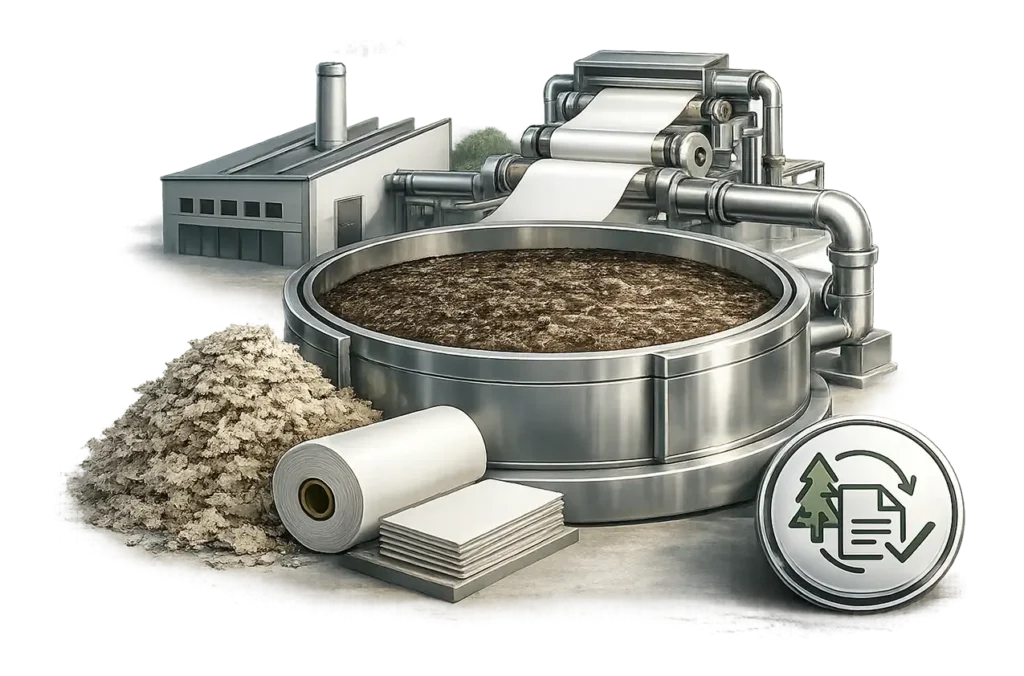
Identificació
Codi LER
03 03 05, 03 03 09, 03 03 10, 03 03 11 segons origen i composició.
Sector / origen general
Producció de pasta, paper i cartró, incloent fàbriques integrades, fàbriques de paper reciclat, instal·lacions de desentintat (deinking) i fàbriques de cartró.
Codi CNAE associat
Principalment CNAE 17.11, 17.12, 17.21, 17.22 i 17.23.
Procés on es genera
Tractament primari i biològic d'aigües residuals industrials (EDARI) i recuperació de fibres durant la fabricació de pasta, paper i cartró.
Procés específic / activitat
Fabricació de pasta química (kraft, sulfit), pasta mecànica i quimitermomecànica (TMP, CTMP), producció de paper i cartró, reciclatge de paper recuperat (RCF) amb o sense desentintat (deinking), depuració biològica i recuperació de fibres i càrregues minerals.
Origen del corrent
Fangs procedents de decantació primària, flotació, recuperació de fibres, tractaments fisicoquímics i processos biològics de les EDARI papereres.
Volum estimat a Catalunya
Un dels principals corrents residuals del sector paperer català, especialment en plantes de reciclatge de paper i cartró.
Alt
Característiques clau 
Matèria seca
20–70
%
Matèria orgànica
35–75
% MS
Nitrogen total
0,2–4
% MS
Fòsfor total
0,01–0,8
% MS
Potassi
0,01–1,8
% MS
Relació C/N
20–200
Qualitat i contaminants
Metalls pesants
Els metalls pesants acostumen a presentar concentracions moderades i generalment inferiors a les observades en sectors com curtits o tractament de superfícies. 
Sí (nivell baix-mitjà reportat en estudis)
  • Recuperació de nutrients (fòsfor)

  • Producció de fertilitzant

  • Millora del procés de tractament de fangs Recuperació de nutrients (fòsfor)
Producció de fertilitzant
 Millora del procés de tractament de fangs
Fonts i referències:
  • European Commission, Joint Research Centre (2015). Best Available Techniques (BAT) Reference Document for the Production of Pulp, Paper and Board (PP BREF). Luxembourg: Publications Office of the European Union. [PP_revised_BREF_2015 | PDF]
  • Abdullah, N., Chin, N. L., Mokhtar, M. N. i Taip, F. S. (2015). Physico-Chemical Characteristics of Paper Mill Sludges from Different Paper Industry Sites and Their Potential Agricultural Utilisation.
  • Camberato, J. J., Gagnon, B., Angers, D. A., Chantigny, M. H. i Pan, W. L. (1997). Pulp and Paper Mill By-Products as Soil Amendments and Plant Nutrient Sources. Canadian Journal of Soil Science, 77, 597–607.
  • Kuokkanen, T., Nurmesniemi, H., Pöykiö, R. i Keiski, R. L. (2015). Chemical and Physical Characteristics of Paper Mill Sludge for Potential Beneficial Use as Soil Amendment and Construction Material.
  • Veluchamy, C. i Kalamdhad, A. S. (2017). Composting of Pulp and Paper Mill Sludge: Characterization, Process Performance and Compost Quality. Bioresource Technology, 242, 325–335.
  • Hazarika, J. N. i Khwairakpam, M. (2018). Vermicomposting of Pulp and Paper Mill Sludge with Cow Dung and Saw Dust: Process Performance and Compost Quality.
  • Zawadzińska, A., Salachna, P. i Piechocki, R. (2022). Co-Composting of Pulp and Paper Mill Sludge, Fruit and Vegetable Waste and Agricultural Residues: Evaluation of Feedstock Characteristics and Compost Quality.
  • Kominko, H., Gorazda, K., Wzorek, Z. i altres (2024). Agronomic Utilisation of Deinking Paper Sludge and Its Conversion into Value-Added Products.
  • Bretzel, F., Ben Hassine, H., Dimambro, M. E. i altres (2024). Evaluating the Properties of Deinking Paper Sludge from the Mediterranean Area for Recycling in Local Areas as a Soil Amendment and to Enhance Growth Substrates.

Fonts complementàries 

  • Beauchamp, C. J., Charest, M. H. i Gosselin, A. (2002). Examination of Deinking Paper Sludge as a Potential Substrate for Compost Production and Land Application. Chemosphere, 46, 887–895. 
  • Gopinathan, R. i Thirumurthy, M. (2012). Composting of Paper and Pulp Mill Secondary Sludge with Organic Amendments and Evaluation of Compost Quality. 
  • Farhain, S. A., Thomas, S. C., Prescott, C. E. i Titus, B. D. (2022). Potential of Developing Podzolic Soil-Based Potting Media from Wood Ash, Paper Sludge and Biochar. 
  • Hasan, M. A., Islam, M. T. i altres (2025). Characteristics, Management and Valorisation Pathways of Pulp and Paper Mill Sludge: A Review. 
  • Feagley, S. E., Valdez, M. S. i Hudnall, W. H. (1994). Papermill Sludge and Compost Utilization for Mine Land Reclamation. 
  • Pichtel, J. R., Dick, W. A. i Sutton, P. (1994). Comparison of Amendments and Fertilisers for Revegetation of Acidic Mine Spoils. 
  • NCASI – National Council for Air and Stream Improvement (1991). Characteristics and Land Application of Pulp and Paper Mill Sludges. 
  • Alier, S.A. (dades industrials no publicades). Caracterització de fangs primaris i fangs activats procedents d’una fàbrica catalana de paper i cartró reciclat. 

Tecnologies amb les que tractar-ho

Compostatge
Tractament químic (Estabilització alcalina calç)
Tractament tèrmic (Hidròlisi tèrmica)
Tractament ultrasons
Digestió anaeròbia

Casos d'èxit

Casos d'exit que hem tingut amb el Fang de depuradora urbana digerit

Taulers de cel·lulosa a partir de fang de la indústria paperera

HONEXT®